
Java基础复习-集合
Java基础复习-集合
0.什么是Java Collection(集合类)
Java的Collection分为两个大类接口,一类是Map,另一类是Collection,这两个接口又依次往下派生了各种集合类型。最主要的四大类型是List, Set, Queue, Map。 具体的派生情况如下图所示
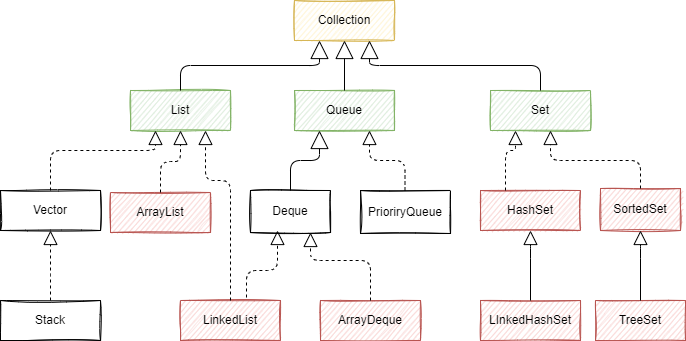
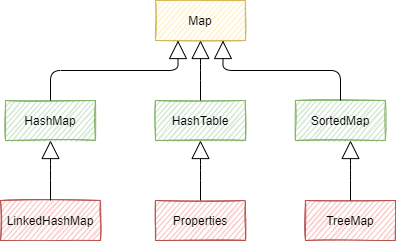
- List 以索引来存取元素,有序的,元素是允许重复的,可以插入多个null;
- Set 不能存放重复元素,无序的,只允许一个null;
- Map 保存键值对映射;List 底层实现有数组、链表两种方式;
- Set、Map 容器有基于哈希存储和红黑树两种方式实现;
- Set 基于 Map 实现,Set 里的元素值就是 Map的键值
在这些派生集合类中,我们最常用的是ArrayList, LinkedList, HashMap, PriorityQueue, Deque, HashSet
集合方法接口
(1)单元素添加、删除操作
//将对象添加给集合
boolean add(Object o)

//如果集合中有与o相匹配的对象,则删除对象o,若有多个匹配则只删第一个
boolean remove(Object o)
(2)查询操作
//返回当前集合中元素的数量
int size()

//判断结合中是否有任何元素
boolean isEmpty()

//查找集合中是否含有元素o
boolean contains(Object o)

//返回一个迭代器,用来访问集合中的各个元素
Iterator iterator()
(3)组操作:作用于元素或整个结合
//查找集合中是否含有集合c中的所有元素
boolean containsAll(Collection c)

//将集合c中的所有元素添加给该集合
boolean addAll(Collectiion c)

//删除集合中所有的元素
void clear()

//从集合中删除集合c中的所有元素
void removeAll(Collection c)

//从集合中删除集合c中不包含的元素
void retainAll(Collection c)
(4)Collection转换为Object数组
///返回一个内含集合所有元素的数组
Object[] toArray()

//返回一个内含集合所有元素的数组。运行期返回的数组和参数a的类型相同
Object[] toArray(Object[] a)
做完了对集合类的简单介绍,下面将针对这些集合类的底层源码做分析
1.ArrayList
ArrayList是我们最常用的一种数据结构,我们通常将其作为动态数组使用。
ArrayList底层通过一个elementData[]数组用于储存数据,在调用add()方法时,会进行容量判断。如果数组可以容纳新元素,则直接将元素加入数组中,无事发生。而如果数组不能够容纳新元素,那么就需要调用grow()方法进行扩容,一般来说ArrayList扩容是扩1.5倍。
public boolean add(E e) {
    //判断是否可以容纳e,若能,则直接添加在末尾;若不能,则进行扩容,然后再把e添加在末尾
    ensureCapacityInternal(size + 1);  // Increments modCount!!
    //将e添加到数组末尾
    elementData[size++] = e;
    return true;
    }
private void grow(int minCapacity) {
        // 获取elementData数组的内存空间长度
        int oldCapacity = elementData.length;
        // 扩容至原来的1.5倍
        int newCapacity = oldCapacity + (oldCapacity >> 1);
        //校验容量是否够
        if (newCapacity - minCapacity < 0)
            newCapacity = minCapacity;
        //若预设值大于默认的最大值,检查是否溢出
        if (newCapacity - MAX_ARRAY_SIZE > 0)
            newCapacity = hugeCapacity(minCapacity);
        // 调用Arrays.copyOf方法将elementData数组指向新的内存空间
         //并将elementData的数据复制到新的内存空间
        elementData = Arrays.copyOf(elementData, newCapacity);
2.Vector
与ArrayList大致相同,扩容扩2倍,多了同步机制使得线程安全,但效率较低,不推荐使用。
3.Stack
栈数据结构,但由于继承了Vector类及其所有方法,与栈操作严重冲突,目前已被废弃。在jdk8,官方推荐使用同样具有LIFO功能的双端队列代替栈,实际上Java目前不提供严格意义上的Stack数据结构
//使用Deque代替栈
Deque<E> stack = new ArrayDeque<>();
4.LinkedList
LinkedList同时继承了List和Queue两个接口,这种集合是作为双向链表实现的,线程不安全。
对于index访问的方法,链表需要移动指针在数组中逐渐寻找,效果不如ArrayList
而对于元素的增删,LinkedList则更优,因为无需考虑扩容、复制等操作,仅仅需要修改指针即可。
LinkedList的链表结点使用一个Node类实现,一个Node包括他两侧指向的Node和储存的元素
    private static class Node<E> {
        E item;
        Node<E> next;
        Node<E> prev;

        Node(Node<E> prev, E element, Node<E> next) {
            this.item = element;
            this.next = next;
            this.prev = prev;
        }
    }
每个LinkedList都可以直接访问首尾的两个Node,通过调用addFirst(),addLast(),getFirst(),getLast()等方法实现
public class LinkedList<E>
    extends AbstractSequentialList<E>
    implements List<E>, Deque<E>, Cloneable, java.io.Serializable
{
    transient int size = 0;

    /**
     * Pointer to first node.
     */
    transient Node<E> first;

    /**
     * Pointer to last node.
     */
    transient Node<E> last;
    //下略...
}
3.5 Queue
Queue是一个接口,该接口要求提供的方法与List也有较大区别,实际提供的方法如下
| 插入 | add(e) | offer(e) |
| 移除 | remove() | poll() |
| 获取 | element() | peek() |
同时Java为了满足线程安全的需求,提供了以下七种阻塞队列(BlockingQueue)
- ArrayBlockingQueue
- LinkedBlockingQueue
- PriorityBlockingQueue
- DelayQueue
- SynchronousQueue
- LinkedTransferQueue
- LinkedBlockingDeque
JDK使用通知模式实现阻塞队列。所谓通知模式,就是当生产者往满的队列里添加元素时会阻塞生产者,当消费者消费了一个队列中的元素后,会通知生产者当前队列可用。
4.Deque
Deque是双端队列接口,同时也继承了Queue接口,主要提供了以下特色方法
| 插入 | addFirst(e) | offerFirst(e) | addLast(e) | offerLast(e) |
| 删除 | removeFirst() | pollFirst() | removeLast() | pollLast() |
| 获取 | getFirst() | peekFirst() | getLast() | peekLast() |
5.ArrayDeque
ArrayDeque是实现了Deque的双端队列实现类,用来当作双端队列或者栈,方法如下
| 操作 | 栈顶 | 队首 | 队尾 |
|---|---|---|---|
| 插入 | push(e) | offerFirst(e) | offer(e) |
| 删除 | pop() | poll() | pollLast() |
| 获取 | peek() | peek() | peekLast() |
不推荐使用add()或者remove()方法,缺乏异常处理机制,用offer()和poll()代替 pop()也常用poll()替代
ArrayDeque使用一个Object[] elements数组来储存队列数据
public class ArrayDeque<E> extends AbstractCollection<E>
                           implements Deque<E>, Cloneable, Serializable
{
    /*
     * VMs excel at optimizing simple array loops where indices are
     * incrementing or decrementing over a valid slice, e.g.
     *
     * for (int i = start; i < end; i++) ... elements[i]
     *
     * Because in a circular array, elements are in general stored in
     * two disjoint such slices, we help the VM by writing unusual
     * nested loops for all traversals over the elements.  Having only
     * one hot inner loop body instead of two or three eases human
     * maintenance and encourages VM loop inlining into the caller.
     */

    /**
     * The array in which the elements of the deque are stored.
     * All array cells not holding deque elements are always null.
     * The array always has at least one null slot (at tail).
     */
    transient Object[] elements;

    /**
     * 指向队列头部的索引
     * 如果 0 <= head < elements.length 等于 tail 则这个双端队列为空
     */
    transient int head;

    /**
     * 指向下一个加入到队列尾部元素的位置(tail-1是当前最后一个元素的位置)
     * elements[tail] 始终 null.
     */
    transient int tail;

    /**
     * The maximum size of array to allocate.
     * Some VMs reserve some header words in an array.
     * Attempts to allocate larger arrays may result in
     * OutOfMemoryError: Requested array size exceeds VM limit
     */
    private static final int MAX_ARRAY_SIZE = Integer.MAX_VALUE - 8;
//方法略
}
6.PriorityQueue
优先队列,往往起到与小根堆、大根堆这类数据结构相同的作用,主要是在加入数据时会自动按照比较器规则排列元素。
使用二叉堆的形式实现,不能够加入不可比较的元素(如空元素)
线程不安全,但是提供了线程安全的PriorityBlockingQueue集合类
public class PriorityQueue<E> extends AbstractQueue<E>
    implements java.io.Serializable {

    @java.io.Serial
    private static final long serialVersionUID = -7720805057305804111L;

    private static final int DEFAULT_INITIAL_CAPACITY = 11;

    /**
     * Priority queue represented as a balanced binary heap: the two
     * children of queue[n] are queue[2*n+1] and queue[2*(n+1)].  The
     * priority queue is ordered by comparator, or by the elements'
     * natural ordering, if comparator is null: For each node n in the
     * heap and each descendant d of n, n <= d.  The element with the
     * lowest value is in queue[0], assuming the queue is nonempty.
     */
    transient Object[] queue; // non-private to simplify nested class access

    /**
     * The number of elements in the priority queue.
     */
    int size;

    /**
     * 比较器,默认为元素自然顺序(数字从小到大,字符按照字典顺序)
     */
    @SuppressWarnings("serial") // Conditionally serializable
    private final Comparator<? super E> comparator;

    /**
     * The number of times this priority queue has been
     * <i>structurally modified</i>.  See AbstractList for gory details.
     */
    transient int modCount;     // non-private to simplify nested class access

//后略
}
在源码中,优先队列的增加操作是如下实现的:
////add调用offer()
public boolean add(E e) {
        return offer(e);
    }

////offer调用siftUp()对堆进行调整,并在插入空元素时抛出异常
public boolean offer(E e) {
        if (e == null)
            throw new NullPointerException();
        modCount++;
        int i = size;
        if (i >= queue.length)
            grow(i + 1);
        siftUp(i, e);
        size = i + 1;
        return true;
    }

////siftUp()根据比较器选择子方法
 private void siftUp(int k, E x) {
        if (comparator != null)
            siftUpUsingComparator(k, x, queue, comparator);
        else
            siftUpComparable(k, x, queue);
    }

////关键主要的添加环节操作如下
    private static <T> void siftUpComparable(int k, T x, Object[] es) {
        Comparable<? super T> key = (Comparable<? super T>) x;
        while (k > 0) {
            //借助无符号数右移计算堆的父节点
            int parent = (k - 1) >>> 1;
            //获取父节点数据,进行比较,根据比较情况确定是否交换
            Object e = es[parent];
            if (key.compareTo((T) e) >= 0)
                break;
            es[k] = e;
            k = parent;
        }
        es[k] = key;
    }

    private static <T> void siftUpUsingComparator(
        int k, T x, Object[] es, Comparator<? super T> cmp) {
        while (k > 0) {
            int parent = (k - 1) >>> 1;
            Object e = es[parent];
            if (cmp.compare(x, (T) e) >= 0)
                break;
            es[k] = e;
            k = parent;
        }
        es[k] = x;
    }
7.HashSet
HashSet实现了Set接口,内部通过HashMap进行实现,HashSet通过成员对象计算hashCode的值
public class HashSet<E>
    extends AbstractSet<E>
    implements Set<E>, Cloneable, java.io.Serializable
{
    @java.io.Serial
    static final long serialVersionUID = -5024744406713321676L;

    transient HashMap<E,Object> map;

    // Dummy value to associate with an Object in the backing Map
    static final Object PRESENT = new Object();

    /**
     *创建一个新的空集,默认容量为16
     *默认加载因子是0.75(即到达0.75倍容量时会进行扩容)
     */
    public HashSet() {
        map = new HashMap<>();
    }
}
要注意HashSet只存储Value值,不存在键值对关系,但是HashSet的Value值就是底层HashMap的Key值,而map对应的Value值则是一个固定常量对象PRESENT
//HashSet添加元素
public boolean add(E e) {
    return map.put(e, PRESENT)==null;
}
8.LinkedHashSet
继承了HashSet的类,是哈希表与链表的结合,提供了可预测的迭代顺序
9.SortedSet
继承了Set的一个接口,和优先队列一样具有有序性质,会随着元素增减进行自动调整,具体实现由TreeSet实现
10.TreeSet
TreeSet实现了SortedSet接口,基于TreeMap进行实现
11.HashMap
哈希表使用链表或者红黑树(由结点数目确定)来储存键值对数据
键值对数据通过Node内部类进行储存,包括键值信息、指向下一个Node的指针对象
默认初始容量为16,默认的初始化加载因子为0.75,即容量超出75%时会触发扩容机制,每次扩到原来的两倍
    static class Node<K,V> implements Map.Entry<K,V> {
        final int hash;
        final K key;
        V value;
        Node<K,V> next;

        Node(int hash, K key, V value, Node<K,V> next) {
            this.hash = hash;
            this.key = key;
            this.value = value;
            this.next = next;
        }

        public final K getKey()        { return key; }
        public final V getValue()      { return value; }
        public final String toString() { return key + "=" + value; }

        public final int hashCode() {
            return Objects.hashCode(key) ^ Objects.hashCode(value);
        }

        public final V setValue(V newValue) {
            V oldValue = value;
            value = newValue;
            return oldValue;
        }

        public final boolean equals(Object o) {
            if (o == this)
                return true;

            return o instanceof Map.Entry<?, ?> e
                    && Objects.equals(key, e.getKey())
                    && Objects.equals(value, e.getValue());
        }
    }
在没有重写hashCode()方法的情况下,系统会根据数据类型采用相应的策略计算哈希值,例如int返回原数值,String根据字符串内容计算哈希值
在哈希表中,数据储存的index与哈希值相关,实际算法如下
    static final int hash(Object key) {
        int h;
        //通过键值的hashCode与对应hashCode右移16位进行异或得到hash值
        return (key == null) ? 0 : (h = key.hashCode()) ^ (h >>> 16);
    }
12.LinkedHashMap
继承了HashMap,底层数据结构修改为了双向链表,HashMap的Node类也被继承,并且加入了分别指向前后两个Node的指针,通过这种储存方式可以实现LRU(最近最少使用)的淘汰策略
    public class LinkedHashMap<K,V>
    extends HashMap<K,V>
    implements SequencedMap<K,V>
{

    /**
     * 对原HashMap的Node类继承
     */
    static class Entry<K,V> extends HashMap.Node<K,V> {
        Entry<K,V> before, after;
        Entry(int hash, K key, V value, Node<K,V> next) {
            super(hash, key, value, next);
        }
    }

    @java.io.Serial
    private static final long serialVersionUID = 3801124242820219131L;

    /**
     * 旧结点
     */
    transient LinkedHashMap.Entry<K,V> head;

    /**
     * 新结点
     */
    transient LinkedHashMap.Entry<K,V> tail;
}
13.HashTable
实现了Map接口,是线程安全的一种集合,不允许null键或null值。整体与HashMap基本相同
14.Properties
继承了HashTable,用于管理配置信息
15.SortedMap
SortedMap是继承了Map的接口,用于实现键的排序功能
16.TreeMap
TreeMap通过红黑树进行实现,红黑树的结点由Entry类实现,实现对传入Key的排序
static final class Entry<K,V> implements Map.Entry<K,V> {
        K key;
        V value;
        Entry<K,V> left;
        Entry<K,V> right;
        Entry<K,V> parent;
        boolean color = BLACK;
}
线程安全
线性安全的集合类:
- Vector:比ArrayList多了同步机制。
- Hashtable。
- ConcurrentHashMap:是一种高效并且线程安全的集合。
- Stack:栈,也是线程安全的,继承于Vector。
线性不安全的集合类:
- Hashmap
- Arraylist
- LinkedList
- HashSet
- TreeSet
- TreeMap